|
|
Hi there, this is your daily ☕️ DevShot.
|
|
|
In today's DevShot:
|
|
🪁 Cloudflare launches AI agent browser 📌 Meta launches Muse Code coding agent 🔌 Five AI giants back shared plugin standard 🤖 Claude Code enables auto mode by default 🛠️ Stripe automates database fixes 🅰️ Angular v22 ships stable signal forms Plus: 🎁 5 other news you might like, 🛠️ 5 tutorials, 🧰 6 tools, and 📚 5 papers.
|
|
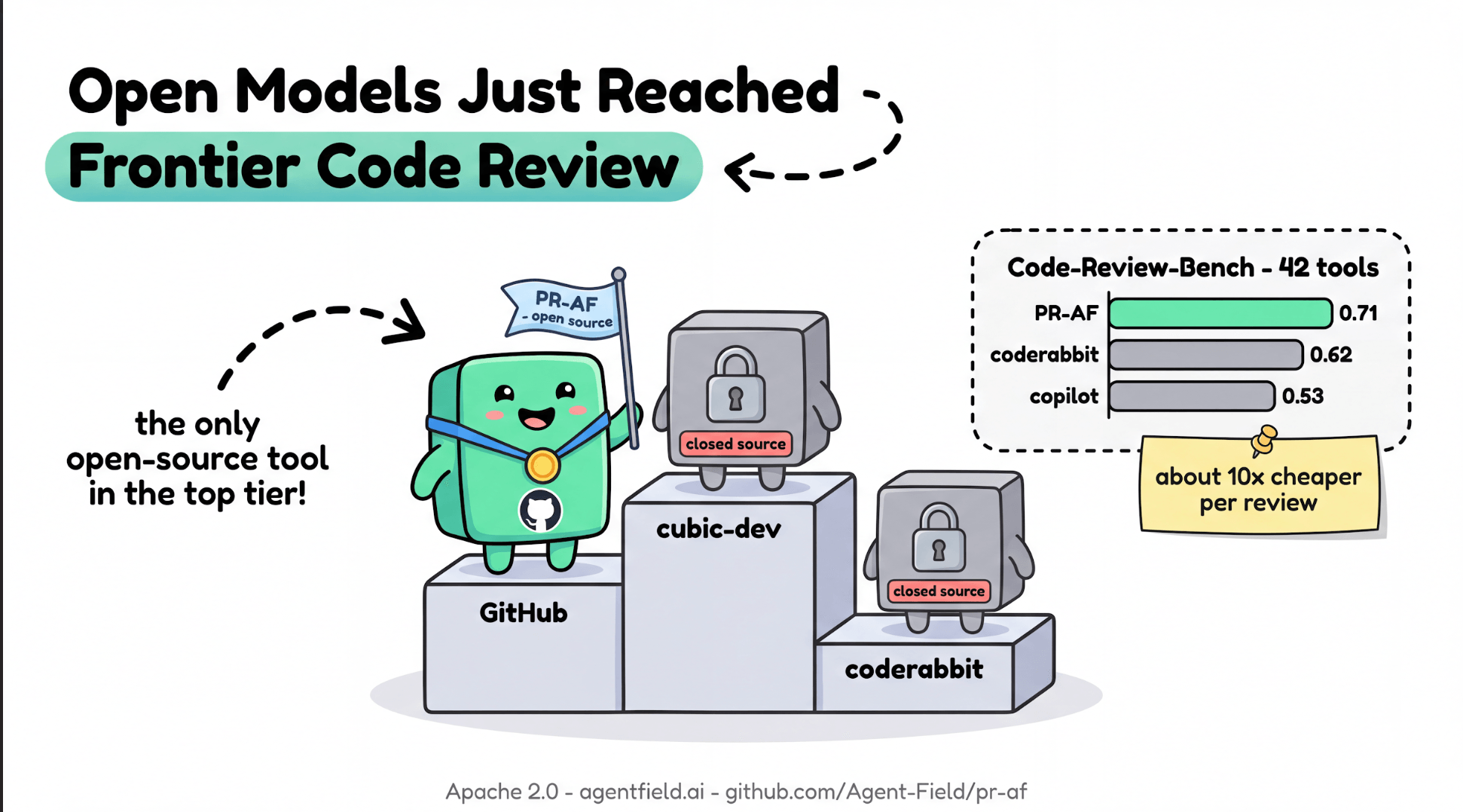
PR-AF ranks #2 of 42 on Martian's Code-Review-Bench: 0.706 recall, roughly 3x more valid findings than commercial tools, at ~10x lower cost per review. It plans a review strategy per pull request, runs reviewer agents in parallel, and verifies every finding against your source, dropping anything unprovable. No hallucinated comments. Apache 2.0, self-hosted, runs on any open or closed model. Drops into GitHub Actions. |
|
|
🪁 Cloudflare launches AI agent browser
LINK
|
- Cloudflare has released Kitesurf, a cloud-hosted browser built specifically for AI agents rather than human users, letting developers build software that navigates sites, fills forms, and completes browser tasks without writing their own browser.
- Running entirely on Workers, Kitesurf drops visual features like tabs and extensions to focus on context windows, token costs, and scalability, claiming lower CPU and memory use than Chromium for tasks like screenshots and HTML extraction.
- Assembled from Blitz's rendering engine, Firefox's Stylo CSS parser, and the Rust-based Boa JS engine, Kitesurf passes roughly 215,000 web platform tests and is free during beta via Browser Run for controlling headless instances.
|
📌 Meta launches Muse Code coding agent
LINK
|
- Meta released Muse Code in beta, a terminal-only coding agent powered by its new Muse Spark 1.2 model, built to plan changes, write code, and validate results across large repositories.
- The agent coordinates multiple persistent subagents per task to tackle complex engineering problems faster and with less hands-on intervention, and stays terminal-only for now rather than shipping a native or Electron app.
- Pricing splits into two model IDs: standard muse-spark-1.2 costs $1.25/$4.25 per million input/output tokens, while muse-spark-1.2-contributor drops over 10× to $0.10/$0.20 if you let Meta use your code and data.
|
🔌 Five AI giants back shared plugin standard
LINK
|
- Vercel published the initial Agent Plugins 1.0 spec on Thursday with backing from Amazon, Cursor, Microsoft, and OpenAI, aiming to let developers write agentic skills and tools once and run them across supporting platforms.
- The spec packages an agent's capabilities into a single directory with a JSON manifest, a skills sub-directory built on Anthropic's Agent Skills, and an mcp.json for MCP server config, plus a namespace folder for client-specific extensions.
- VS Code, Cursor, GitHub Copilot, ChatGPT, Codex, and Kiro already support the standard, which runs under the Linux Foundation's AAIF with open governance, a technical oversight committee, and a CC-BY-4.0 license.
|
🤖 Claude Code enables auto mode by default
LINK
|
- Claude Code will run in auto mode by default for Pro, Max, and Team users starting August 14, letting Anthropic's coding agent execute tasks on its own without asking approval for each one unless settings are changed.
- Anthropic's tests found auto mode flagged 89% of dangerous commands versus 13.6% for manual human review, a gap that widened over long sessions where human detection fell to ~5% after 50 prompts.
- Auto mode blocks risky commands and reverts to manual approval after three consecutive blocks or 20 per session; paired with Opus 5 for parallel long-running tasks, Teams and Enterprise adopters ship ~25% more pull requests.
|
🛠️ Stripe automates database fixes
LINK
|
- Stripe automated its MongoDB incident recovery by modeling its global infrastructure as a graph, using graph search algorithms and state machines to compute and execute remediation plans without manual intervention.
- The system adapts dynamically to different shard layouts, cutting database pager alerts by roughly 30%, around 200 fewer pages yearly, and eliminating an estimated 12 days of unhealthy shard states per year.
- Stripe first used BFS to find recovery paths, then switched to Dijkstra's algorithm to prioritize lower-cost plans, and now plans to extend the framework to topology changes, blue-green deployments, and planned maintenance.
|
🅰️ Angular v22 ships stable signal forms
LINK
|
- Angular v22 has landed, promoting Signal Forms to stable along with a batch of template improvements, dependency-injection additions, and experimental tooling aimed at in-browser AI coding agents.
- Signal Forms combine the strong typing of reactive forms with the ergonomics of template-driven forms into one declarative, signal-based API, now shipping with full docs plus Angular Material and Angular Aria support.
- The upgrade requires TypeScript 6, drops Node 20, flips the default change-detection strategy, and switches the HTTP client to Fetch, with schematics handling most migrations though two changes need manual attention and Webpack support is deprecated.
|
|
Stop typing what you could say in 10 seconds.Wispr Flow turns your voice into clean, professional text inside any app. Emails, Slack, client updates — speak once, send without editing. 4x faster than typing.
📚 Tutorials & Advice
|
> How to Run Terraform in bitbucket pipelines: Explains how to automate Terraform infrastructure changes by defining reusable pipeline steps in Bitbucket Pipelines that authenticate to AWS without storing long-lived credentials.
|
|
> Using and styling the dialog element: Use the HTML dialog element as a true modal so browsers handle focus trapping and page inertness natively, then style and animate it with CSS.
|
|
> Profile-guided optimization in Go: Profile-guided optimization records where a Go program actually spends its time and feeds that to the compiler for a second build, yielding modest 2-4% speedups nearly for free.
|
|
|
🔗 Other News & Articles
-
Django is moving to an annual release cycle
LINK
-
How pinterest secures AWS infrastructure at Scale with a centralized terraform pipeline
LINK
-
Hardware researcher spins up 'CPU deoptimization' project to find the slowest single x86 instruction, creates hall of shame — worst offender takes 198 billion cycles spanning 62 seconds to execute
LINK
-
Google open-sources TPU Raiden for faster AI inference
LINK
-
GitHub Hardens npm and actions defaults, Drawing Debate over delays versus signing
LINK
|
|
📄 Papers & Resources
|
> Flaky test detection for cyber-physical systems like self-driving cars now flags unreliable pass or fail results caused by unpredictable real-world conditions, using just one extra round of testing.
LINK
|
|
> Software refactoring's energy cost varies so much with workload that nearly half of tested code changes flip between saving and wasting energy depending on conditions, meaning cleanup code can quietly raise cloud power bills.
LINK
|
|
> Macro translation for C-to-Rust conversion pairs a rule-based tool with AI, together converting 22% to 77% more of common C shortcut code than the rule-based tool alone, cutting manual rewrite work for safety-critical software.
LINK
|
|
> Stress-testing AI agents shows that deliberately injecting errors into the AI responses they rely on can crash task success rates by up to 50 percentage points, revealing that reliability depends more on how a system is built than which underlying model powers it.
LINK
|
|
> AI code generators that "think out loud" before writing code cut biased outputs nearly in half versus direct generation, but a new fix that rewrites biased reasoning first slashes bias by ~84% while keeping code quality intact.
LINK
|
|
|
|
🧰 Latest Tools
| BugHerd: lets clients point, click and comment on a page, then turns that into a task with a screenshot and the tech details attached. START A FREE 7-DAY TRIAL |
|
Sim: a workspace for building and deploying AI agents visually or with code, connecting to 1,000+ integrations and every major LLM provider.
LINK
|
|
Prelint: reviews AI-generated pull requests against your ADRs, docs, and past decisions to catch product drift before it ships.
LINK
|
|
ZooData: converts webpages into structured JSON, reducing LLM token usage by 75% while providing pre-analyzed Amazon and TikTok e-commerce data for AI agents.
LINK
|
|
CartAI: automates online checkout across merchant sites via a single API call, managing payments, shipping, and order tracking without per-site integrations.
LINK
|
|
ditto.site: converts any public URL into clean Next.js or Vite code deterministically, preserving components, design tokens, and hover states via a free API or MCP server.
LINK
|
|
Replay QA: records website sessions with devtools access, letting you create detailed, shareable bug reports without running manual QA processes.
LINK
|
|
|
|
💬 How did you find today's edition?
We read every reply — just reply to this email and let us know how we can improve!
|
|
|