|
|
Hi there, this is your daily ☕️ DevShot.
|
|
|
In today's DevShot:
|
|
🐋 DeepSeek launches V4 Pro 🎵 Spotify speeds up its data lake queries 🐳 Docker's new VMM enters public beta ⚡ Astro 7 builds up to 61% faster 🌐 Databricks configures tens of millions of VMs 🐍 Simon Willison releases alchemy-utils 0.1 Plus: 🎁 5 other news you might like, 🛠️ 5 tutorials, 🧰 6 tools, and 📚 5 papers.
|
|
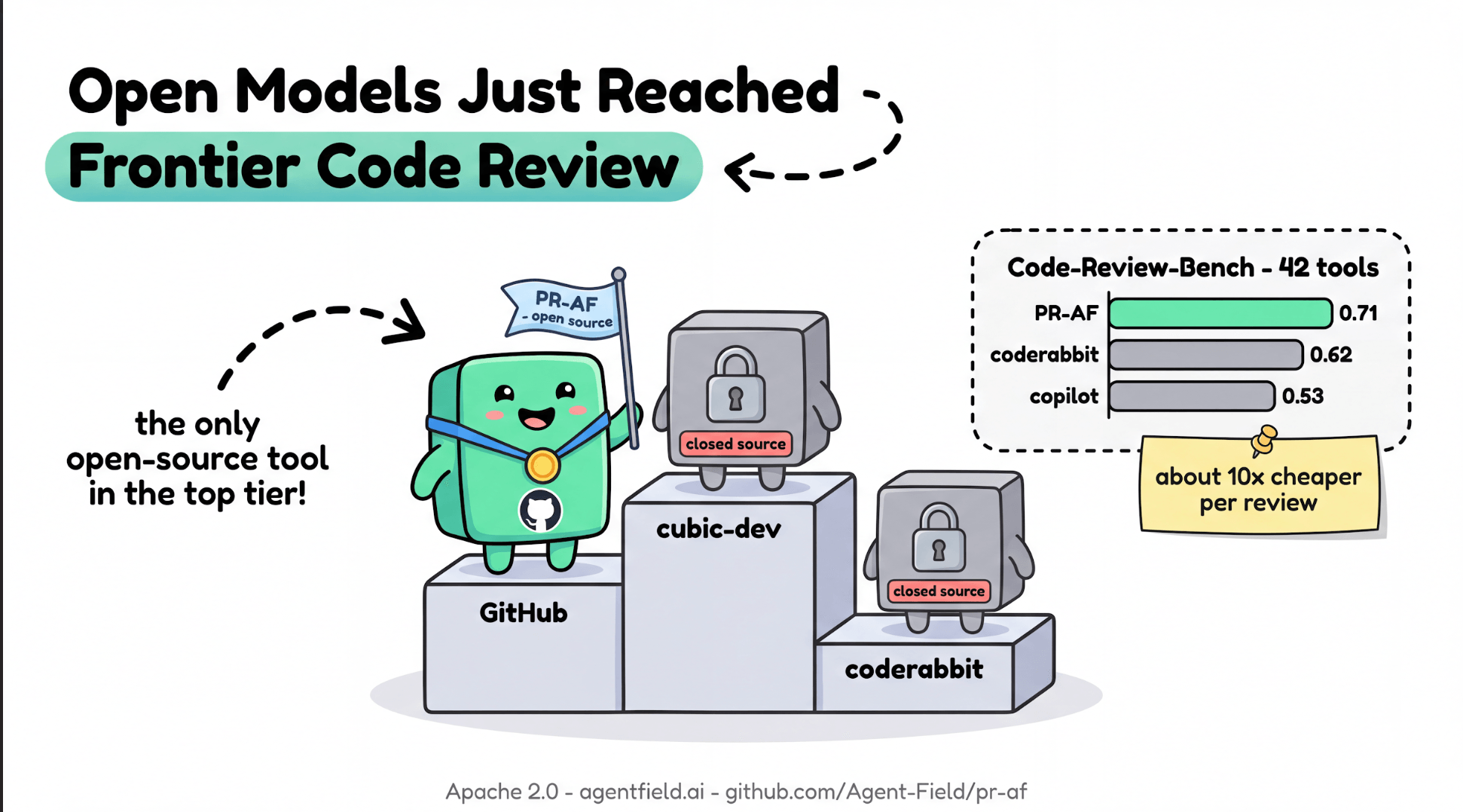
PR-AF ranks #2 of 42 on Martian's Code-Review-Bench: 0.706 recall, roughly 3x more valid findings than commercial tools, at ~10x lower cost per review. It plans a review strategy per pull request, runs reviewer agents in parallel, and verifies every finding against your source, dropping anything unprovable. No hallucinated comments. Apache 2.0, self-hosted, runs on any open or closed model. Drops into GitHub Actions. |
|
|
🐋 DeepSeek launches V4 Pro
LINK
|
- DeepSeek quietly finalized its flagship V4 Pro, shipping the DeepSeek-V4-Pro-0813 build with no blog post-the only signal being an updated version string on its API pricing page after months of the model running as a preview.
- Pricing holds steady at roughly $0.44 per million input tokens and $0.87 per million output, but the weights underneath changed; the earlier scores every independent lab tested described the unfinished preview, so nobody has externally benchmarked 0813 yet.
- DeepSeek's own numbers across 10 agent benchmarks trail Fable 5 by about 5% on average, but on blended rates V4 Pro costs around 46 times less; the MIT-licensed weights sit on Hugging Face for independent verification.
|
🎵 Spotify speeds up its data lake queries
LINK
|
- Spotify built Random Access Parquet (RAP), a storage layer that serves low-latency point queries directly against its data lake, letting online services and AI apps fetch individual records without replicating datasets into operational databases like Bigtable.
- RAP adds an external index mapping keys such as user IDs to specific Parquet files and row locations, so a lookup resolves through the index and issues a targeted ranged read instead of scanning thousands of files.
- Storage optimizations-sorting by lookup key, interleaving columns, and covering indexes-trade modest size increases for fewer operations, serving some point queries in a single few-kilobyte read, while secondary indexes enable multi-dimension queries without rewriting data.
|
🐳 Docker's new VMM enters public beta
LINK
|
- Docker has launched a public beta of Docker VMM, a first-party virtualization layer it built from scratch to replace the third-party VMM under Docker Desktop, available on Mac and Windows in v4.86.
- Developers get faster container startup, quicker host-container file sharing, and memory that returns to the host when containers idle, while Windows gains Hyper-V-level isolation with WSL2-like speed for the first time under a Docker-maintained VMM.
- Mac users already on Docker VMM upgrade automatically; Windows users opt in via Settings > General with no waitlist, Linux support arrives at GA, targeted for late October 2026 when Docker VMM becomes the default for new installs.
|
⚡ Astro 7 builds up to 61% faster
LINK
|
- Astro 7 shipped with its build pipeline rewritten in native code, cutting build times by 15 to 61 percent, with the astro.build site dropping from 63s to 24s and Cloudflare's 8,400-page docs falling from 387s to 262s.
- The compiler moves from Go to a Rust build on oxc and Lightning CSS, Markdown now runs through a Rust processor called Sätteri, and the framework sits on Vite 8 with Rolldown, though remark and unified pipelines remain available.
- Compilation turned stricter, erroring on unclosed tags and passing invalid nesting through as written, while point releases added CSP directives for inline styles, per-route incremental builds in 7.2, and JSON logging for AI coding agents.
|
🌐 Databricks configures tens of millions of VMs
LINK
|
- Databricks re-architected how it delivers network configuration to the tens of millions of VMs its serverless platform launches daily, cutting p99 RPC latency by 97.5% from 5,000ms to 125ms while hitting 99.99% availability.
- The old design synchronously fetched config from multiple upstream services on the cluster-start critical path; the rewrite subscribes to change events via a message queue and pre-computes per-workspace snapshots, so serving becomes a single storage read.
- A periodic reconciler re-syncs all workspaces as a safety net for missed events, and calling upstream only on actual changes rather than every request dropped upstream call volume by 86% across billions of daily requests.
|
🐍 Simon Willison releases alchemy-utils 0.1
LINK
|
- Simon Willison has shipped alchemy-utils 0.1a0, an early alpha of a database-agnostic library and CLI that ports his sqlite-utils API to SQLAlchemy so it works across PostgreSQL, SQLite, and DuckDB.
- The tool mirrors sqlite-utils core methods like insert, upsert, insert_all, upsert_all, create, update, and table introspection, and runs via uvx with per-engine extras such as alchemy-utils[postgresql] or alchemy-utils[duckdb].
- Willison built the prototype using Codex and GPT-5.6 with red/green TDD and pytest; a DuckDB CSV insert of every San Francisco tree initially took nearly an hour, but Codex optimized it down to about 35 seconds.
|
|
Query Billions of Rows in Milliseconds.FlightAware cut a core query from 6.4 seconds to 30 milliseconds, on Postgres. TimescaleDB adds hypertables, up to 95% compression, and continuous aggregates so queries stay fast as data grows. Same SQL, no pipeline, no second database.
🔗 Other News & Articles
-
The web’s newest weapon against AI scrapers is a font
LINK
-
How We’re building scam alert on WhatsApp with End-to-End encryption and Verifiability guarantees
LINK
-
Proton VPN is replacing wireguard-go with a new Rust VPN core
LINK
-
Netflix Adopts Cloud-Native Job queueing system kueue to Replace an In-House solution
LINK
-
Okta targets AI agent token costs with MCP scoping
LINK
|
|
📄 Papers & Resources
|
> Automated bug-hunting for Python software libraries reads their documentation with an AI model to generate valid test inputs, catching 74 issues, with 43 confirmed and 29 already fixed by developers.
LINK
|
|
> Multi-agent coding tools were tested head-to-head on a real task, summarizing README files, and showed no meaningful performance difference between frameworks, though most still lack basic monitoring features developers need.
LINK
|
|
> Code merge conflicts get resolved more accurately across programming languages by a tool that reads code structure only where needed, cutting false alarms without slowing builds or missing real conflicts.
LINK
|
|
> Coding agent toolkits show that how tools are packaged, not just what they can do, matters, since better-structured interfaces made repeated attempts up to 4.7x more consistent, cut steps by ~42%, and lowered token use by ~56%.
LINK
|
|
> Code-writing AI trained with formal proof reasoning behind correct solutions solves far more hard programming tasks, boosting correct answers from 16 to 23 on a tough benchmark, a 44% jump over prior methods.
LINK
|
|
|
|
🧰 Latest Tools
| Emergent: builds a full-stack app from a plain-English description, front end through deploy, and you own the code. Start free today |
|
AnySearch: a search API for AI agents that queries multiple trusted sources in parallel, then filters and de-duplicates results into structured data.
LINK
|
|
Prefactor: an evaluation layer that scores agent runs in real time, catching quality regressions and drift before they impact customers in production.
LINK
|
|
ZooData: converts webpages into structured JSON, cutting LLM token usage by 75% while delivering pre-analyzed Amazon and TikTok e-commerce data for AI agents.
LINK
|
|
CartAI: automates online checkout across merchant sites through a single API call, handling payments, shipping, and order tracking without per-site integrations.
LINK
|
|
ditto.site: turns any public URL into clean Next.js or Vite code deterministically, preserving components, design tokens, and hover states via a free API or MCP server.
LINK
|
|
Replay QA: records website sessions with devtools access, letting you create detailed, shareable bug reports without running manual QA processes.
LINK
|
|
|
|
💬 How did you find today's edition?
We read every reply — just reply to this email and let us know how we can improve!
|
|
|