|
|
Hi there, this is your daily ☕️ DevShot.
|
|
|
In today's DevShot:
|
|
⚡ OpenAI's Ultrafast mode runs GPT-5.6 faster 🤖 Gemini 3.7 Flash cuts price 50% 🛠️ Vercel opens its v0 AI app builder to developers 🔓 Node.js creator open-sources Durable Objects 📦 npm 12 disables install scripts by default 🇨🇳 China's Z.ai launches an open coding model to rival OpenAI Plus: 🎁 5 other news you might like, 🛠️ 5 tutorials, 🧰 6 tools, and 📚 5 papers.
|
|
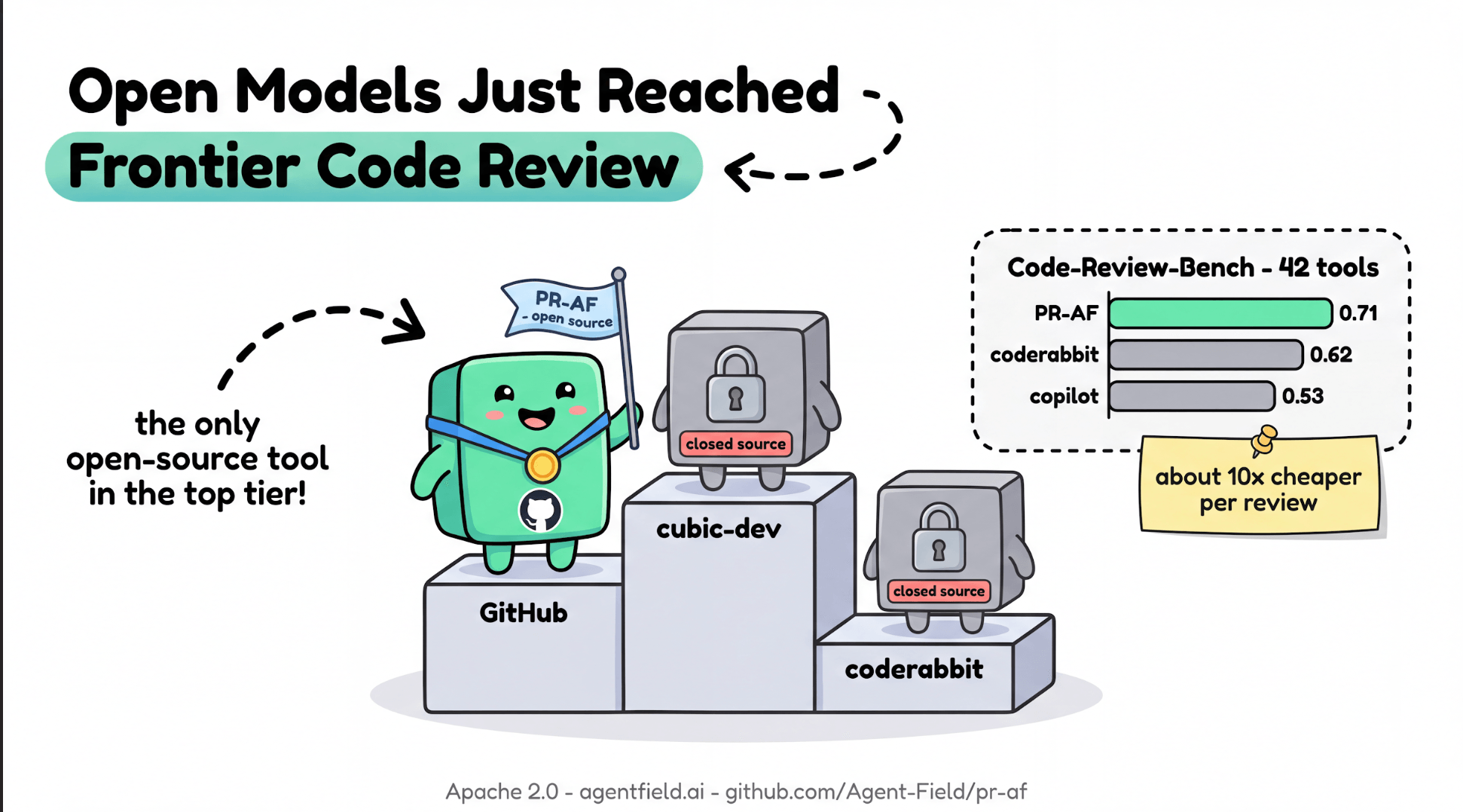
PR-AF ranks #2 of 42 on Martian's Code-Review-Bench: 0.706 recall, roughly 3x more valid findings than commercial tools, at ~10x lower cost per review. It plans a review strategy per pull request, runs reviewer agents in parallel, and verifies every finding against your source, dropping anything unprovable. No hallucinated comments. Apache 2.0, self-hosted, runs on any open or closed model. Drops into GitHub Actions. |
|
|
⚡ OpenAI's Ultrafast mode runs GPT-5.6 faster
LINK
|
- OpenAI has launched GPT-5.6 Sol Ultrafast mode, which runs its frontier model at up to 750 output tokens per second, roughly 14x quicker than Standard processing, without dropping to a smaller or less capable model.
- The speedup comes from Cerebras' Wafer-Scale Engine and its 44GB of on-chip SRAM, cutting the data-movement bottlenecks that cap inference on GPU systems; it cleared Humanity's Last Exam's 2,500 questions in about 11 hours versus 78 for Fable 5.
- OpenAI pitches Ultrafast for incident response, coding, real-time support, and research iteration, and uses it internally to analyze logs during incidents, but Cerebras capacity is limited, so interested customers must apply and be vetted for workload fit.
|
🤖 Gemini 3.7 Flash cuts price 50%
LINK
|
- Google's Gemini 3.7 Flash ships at half the price of its predecessor while posting broad gains over 3.6 Flash across coding, web development, and reasoning over knowledge-heavy documents.
- On coding, it hits higher first-pass accuracy and stronger debugging and issue resolution, scoring 43.6% versus 34.4% on FrontierCode 1.1 Main and 65.3% versus 49.0% on DeepSWE v1.1.
- For UI generation it matches reference screenshots or design systems more closely, reaching a 1588 Elo on WebDev Arena, and jumps to 34% on the GDP.pdf document benchmark from 22%.
|
🛠️ Vercel opens its v0 AI app builder to developers
LINK
|
- Vercel has moved its v0 API to general availability, giving developers programmatic access to the AI app-building agent to send prompts, generate and edit application files, run them in a Sandbox, and get an embeddable preview URL.
- Each app is organized around a chat that tracks state, so follow-up messages reuse the same chat ID, while synchronous, asynchronous, and streaming requests expose individual agent actions like file edits, searches, and Bash commands.
- Apps can be created from GitHub repos, ZIP archives, or file sets, then deployed to a Vercel project, with MCP servers, up to three skills, and integrations for invoking v0 inside other agents via the AI SDK or eve framework.
|
🔓 Node.js creator open-sources Durable Objects
LINK
|
- Ryan Dahl, creator of Node.js, has open-sourced celld, a self-hosted implementation of Cloudflare's Durable Objects and Workers that stays compatible with their JavaScript APIs while removing any dependence on Cloudflare's backend infrastructure.
- Written in Rust and JavaScript under Apache 2, celld swaps Cloudflare's backend for S3-compatible storage and the Tokio runtime, gives each object its own SQLite copy, and runs JavaScript, TypeScript, and WebAssembly-compiled Rust, Go, or Zig.
- Dahl estimates 100 resident cells cost ~$49/month on a DigitalOcean droplet versus $415 on Cloudflare, though Cloudflare counters that idle Durable Objects run about $21; notably, the GitHub page bans AI-generated contributions.
|
📦 npm 12 disables install scripts by default
LINK
|
- npm 12 now blocks dependency install and lifecycle scripts from running by default, requiring developers to review pending scripts, approve trusted ones, and commit the resulting allowlist in package.json before builds proceed.
- The release also blocks implicit builds for packages with a build file, plus scripts from git, file, link and https tarball dependencies, and closes a path where a Git dependency could override the Git executable.
- Available behind warnings since npm 11.16.0, the change trails pnpm, yarn 4.10 and bun 1.3; researchers warn approval fatigue could turn deny-by-default into a click-through prompt, as scripts drove ~53% of malicious npm attacks last year.
|
🇨🇳 China's Z.ai launches an open coding model to rival OpenAI
LINK
|
- Zhipu has released GLM-5.3, which it claims is now the strongest open-weights coding model, with the largest performance gains showing up in agent-based coding tasks compared to its predecessor.
- Built on the same base as GLM-5.2, all improvements come from extended post-training, including cybersecurity data that let the model chain exploitation steps and uncover 2,436 vulnerabilities across 269 projects, some 40 years old.
- The model is available now via the GLM Coding Plan and works with agents like ZCode, Claude Code, and OpenCode, with weights slated to go open source in two weeks once security reviews finish.
|
|
Domain Names + Web and Email Hosting For LessStill paying GoDaddy or Namecheap prices? Porkbun sells most domains at cost for low, transparent registration and renewal pricing with no nonsense. Get free features like WHOIS privacy and SSL certificates, plus real human support 24/7, 365 days a year. Save $1 on your next domain name now.
🔗 Other News & Articles
-
LLM-Generated GraphQL mocks Arrive at Airbnb and Expedia, While the spec Lags Behind
LINK
-
Packer v1.16.0 brings verifiable provenance to machine images
LINK
-
Rx.NET 7.0 Reduces deployment size by Splitting Windows UI support
LINK
-
Three Claude agents given conflicting orders sabotaged each other on a shared server — then didn't tell users what they'd done
LINK
-
Writer says its new Palmyra X6 model cuts AI agent costs by 52% as token spending surges
LINK
|
|
📄 Papers & Resources
|
> Coding-agent benchmarks that only check if a command's final result matches can hide huge swings, one model's score looked flat but actually masked a ~64 point drop from a transport bug and a ~61 point recovery, meaning today's agent leaderboards may rank tools wrong.
LINK
|
|
> AI coding agents are increasingly limited not by task-solving skill but by weak collaboration with human users, so the paper urges building agents optimized for alignment, verifiability, steerability, and adaptability instead of pure autonomy.
LINK
|
|
> Website training data for web-browsing bots is auto-generated by first mapping a site's actual pages and functions, cutting made-up tasks and producing more reliable practice runs, which boosts performance on both familiar and new websites.
LINK
|
|
> AI-led code refactoring let an unsupervised coding agent rewrite a core rule across 189 files of a 717,000-line app, catching 201 bugs itself before any human ever ran the program.
LINK
|
|
> Code AI memorization tests break down at scale, since the usual tricks for spotting whether a coding model just memorized answers stop working on larger models, making contamination scores unreliable and generalization the more important thing to measure instead.
LINK
|
|
|
|
🧰 Latest Tools
| ElevenLabs: turns any script into studio-quality speech in seconds, with 5,000+ voices across 70+ languages. Free to start. GENERATE FOR FREE |
|
Sim: a visual and code-based workspace for building and deploying AI agents, connecting to 1,000+ integrations and every major LLM provider.
LINK
|
|
Prelint: checks AI-generated pull requests against your ADRs, docs, and prior decisions to catch product drift before it ships.
LINK
|
|
SKI: lets you voice-code with Claude Code, Codex, and other agents, getting spoken replies back so you build hands-free at thinking speed.
LINK
|
|
Humalike x Hermes: gives AI agents turn-taking, timing, and memory APIs so they know when to speak, wait, or interrupt naturally.
LINK
|
|
Zro: routes coding requests across open-source models like GLM-5.2, DeepSeek V4 Flash, and Kimi K3 through a single endpoint without storing data.
LINK
|
|
AgentSky: launches managed AI agents like Claude Code, Codex, Hermes, and OpenClaw with automatic recovery, accessible via WhatsApp, Telegram, Slack, web, API, or CLI.
LINK
|
|
|
|
💬 How did you find today's edition?
We read every reply — just reply to this email and let us know how we can improve!
|
|
|