|
|
Hi there, this is your daily ☕️ DevShot.
|
|
|
In today's DevShot:
|
|
🐧 Torvalds embraces AI code review for Linux 🔑 Canva revokes millions of sessions with S3 🤖 Meta's Muse Glimmer runs on one GPU 🐙 GitHub Code Quality now generally available ☕ Java's JEP 401 redefines == for objects ⚡ Convex adds one-command Expo backend Plus: 🎁 5 other news you might like, 🛠️ 5 tutorials, 🧰 6 tools, and 📚 5 papers.
|
|
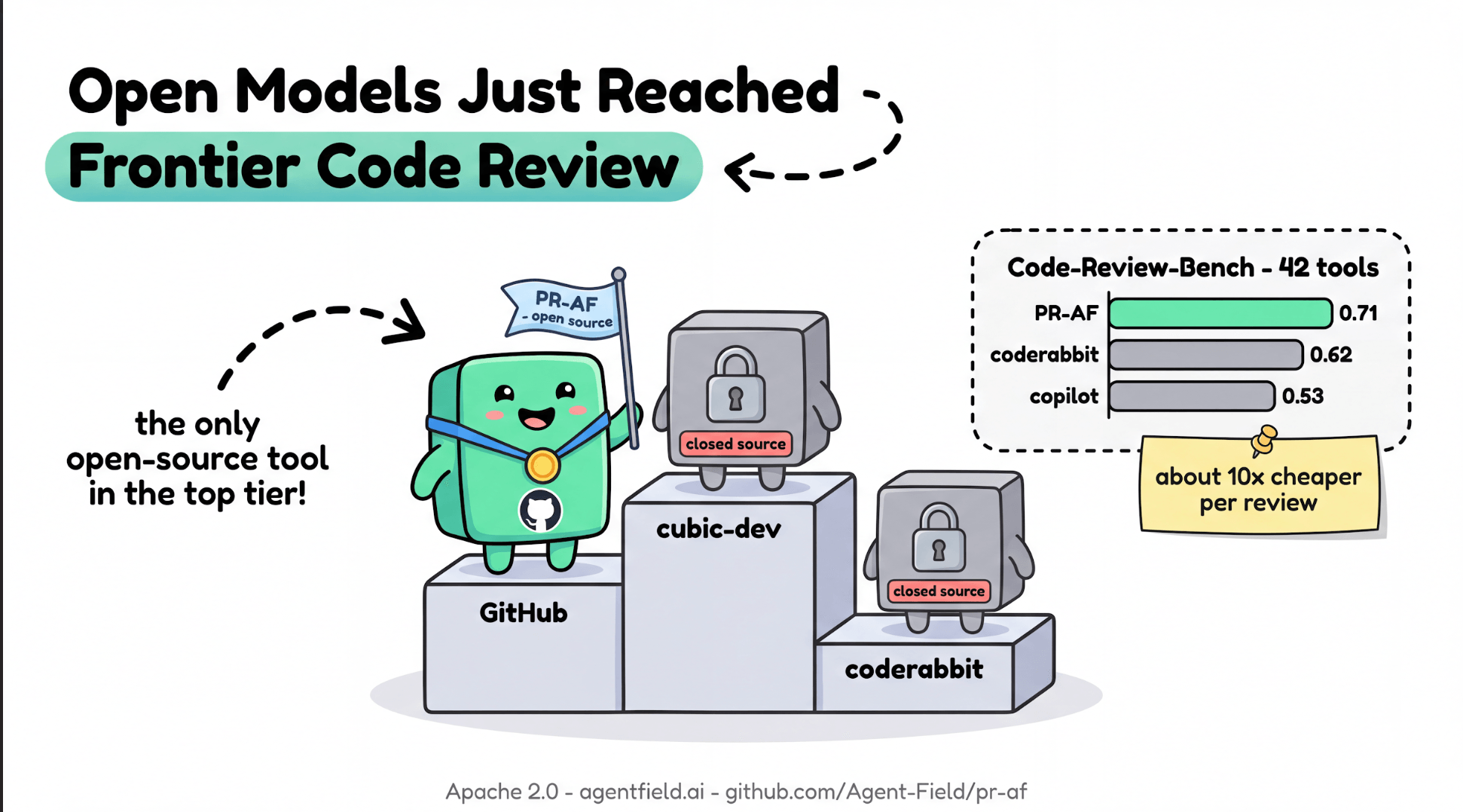
PR-AF ranks #2 of 42 on Martian's Code-Review-Bench: 0.706 recall, roughly 3x more valid findings than commercial tools, at ~10x lower cost per review. It plans a review strategy per pull request, runs reviewer agents in parallel, and verifies every finding against your source, dropping anything unprovable. No hallucinated comments. Apache 2.0, self-hosted, runs on any open or closed model. Drops into GitHub Actions. |
|
|
🐧 Torvalds embraces AI code review for Linux
LINK
|
- Linus Torvalds has accepted AI and LLM tools as a permanent part of Linux kernel review, after Linux 7.2-rc7 landed on August 9 with over 400 fixes he directly credits to automated scanning.
- The candidate touches nearly every subsystem, including a memory management fix in ptdump that closed an eight-year-old use-after-free race Syzbot flagged in June, with Claude Opus 4.8 helping trace the root cause.
- Kernel policy still requires a human to triage and sign off on every AI-assisted contribution, and Torvalds settled the debate in July, telling objectors they could fork or leave; Linux 7.2 stable is expected around August 16.
|
🔑 Canva revokes millions of sessions with S3
LINK
|
- Canva rebuilt its session revocation system to handle hundreds of millions of active sessions, storing revocation data in Amazon S3 as compact immutable records instead of hammering MySQL on every deployment.
- Gateways download the 12-hour revocation window as 30-minute S3 objects, each revocation a 16-byte binary record searched in sorted in-memory arrays, cutting the cache footprint by ~88% while conditional GETs fetch only changed chunks.
- Asynchronous workers process over 2,000 revocations per second and merge them using conditional PUTs for optimistic concurrency, letting Canva shrink its revocation database to two read replicas and scale load with write throughput rather than gateway count.
|
🤖 Meta's Muse Glimmer runs on one GPU
LINK
|
- Meta released Muse Glimmer, a 30-billion-parameter open-weight agent model that runs locally on a single 24GB consumer GPU like an RTX 4090 or a 32GB Apple Silicon Mac, keeping sensitive workflows off the cloud.
- Shipping under Apache 2.0 with weights on Hugging Face, the model was trained around the agent loop, planning, tool calls, self-checking and failure recovery, and ~4-bit quantization shrinks its weights under 20GB with only 0.2-1% accuracy loss.
- DFlash speculative decoding, where a drafter proposes 16-token blocks the main model verifies in parallel, roughly triples generation speed on an RTX 5090 to ~233 tokens/sec, cutting the latency that accumulates across an agent's many turns.
|
🐙 GitHub Code Quality now generally available
LINK
|
- GitHub Code Quality is now generally available on GitHub Enterprise Cloud and GitHub Team, pairing CodeQL analysis with AI-assisted detection of maintainability and reliability issues and Copilot Autofix suggestions surfaced in pull requests.
- On a pull request it reports findings in context and flags test-coverage impact, while on the default branch it surfaces existing quality debt, with rulesets enforcing thresholds and an evaluate mode for gradual rollout.
- It's a separate paid product, not part of Advanced Security, priced at $10 per active committer monthly plus usage charges for AI features; preview users should review where it's enabled to avoid unexpected costs.
|
☕ Java's JEP 401 redefines == for objects
LINK
|
- Java's JEP 401 landed as a preview in JDK 28, adding value classes: identity-free instances with implicitly final fields that redefine == to compare field values rather than object references.
- Declaring a class with the value modifier makes its fields final and bans synchronized instance methods, while == succeeds when operands share the same class and equal fields, comparing reference-typed fields recursively.
- Enabling the preview turns primitive wrappers and other value-based JDK classes into value classes, letting the JVM scalarize or flatten them-sometimes into 64 bits-though it falls back to normal allocation when optimization fails.
|
⚡ Convex adds one-command Expo backend
LINK
|
- Convex and Expo teamed up to let you provision and wire a reactive, fully typed backend to an Expo app with a single EAS CLI command, skipping separate signups, dashboards, and copy-pasted tokens.
- Under the hood the command creates or reuses a Convex team connection, spins up a project and deployment, writes your config, and sets the public deployment URL as an EAS variable across production, preview, and development.
- You write server functions in TypeScript and clients subscribe to them, so results update automatically when data changes; unlinking only strips EAS integration metadata and leaves your Convex data and deployments intact.
|
|
Query Billions of Rows in Milliseconds.FlightAware cut a core query from 6.4 seconds to 30 milliseconds, on Postgres. TimescaleDB adds hypertables, up to 95% compression, and continuous aggregates so queries stay fast as data grows. Same SQL, no pipeline, no second database.
📚 Tutorials & Advice
|
> Animating CSS border-image: Explains how to animate CSS border images by registering custom properties for gradient values, since standard gradients can't transition, creating borders that appear to draw themselves.
|
|
> Breaking up (lines) is hard to do: Python's splitlines() recognizes eleven different line-break markers because decades of clashing operating systems and Unicode's rules for global scripts each added their own.
|
|
|
🔗 Other News & Articles
-
Developer ports Word for Windows 1.1a to modern x64 systems using original source code
LINK
-
Xbox PC and game Pass titles are coming to Linux through 'Xodus' — Heroic Launcher devs embark on new open-source reverse-engineering project
LINK
-
Introducing FILE type: a native column type for multimodal data
LINK
-
AWS continuum integrates with OpenAI codex and Anthropic claude code in major AI security push
LINK
-
New coding technique skips needless calculations, speeding some GPU tasks nearly fourfold
LINK
|
|
📄 Papers & Resources
|
> Foundation-model shopping gets a transparent scorecard instead of popularity rankings, matching commercial AI recommendation tools across 44 test scenarios while showing exactly why each model was picked, from a base of 71,274 models.
LINK
|
|
> Internal correctness signals that let a model's hidden activity flag buggy code without running it turn out to shift depending on how they're extracted, and isolating the specific bug doesn't fix that inconsistency, so this shortcut isn't yet reliable enough to replace testing.
LINK
|
|
> Self-improving coding agent rewrote its own tools and prompts through reviewed updates, then topped coding and computer-use benchmarks, scoring 86.74% and 90.69%, showing AI systems can safely upgrade themselves under human oversight.
LINK
|
|
> Cloud outage diagnosis uses service maps to guide AI investigation of app failures, pinpointing the true root cause on the first guess over 25 percentage points more often than rival AI methods, plus ready-to-act incident fixes.
LINK
|
|
> GUI agent software reviewed ~336 papers and found these interface-automating systems lack proper error recovery, safety checks, and auditability, meaning most aren't yet engineered reliably enough for sustained real-world business use.
LINK
|
|
|
|
🧰 Latest Tools
| ElevenLabs: turns any script into studio-quality speech in seconds, with 5,000+ voices across 70+ languages. Free to start. GENERATE FOR FREE |
|
AnySearch: a search API for AI agents that queries multiple trusted sources in parallel, then filters and de-duplicates results into structured data.
LINK
|
|
Prefactor: an evaluation layer that scores agent runs in real time, catching quality regressions and drift before they impact customers in production.
LINK
|
|
Zro: routes coding requests across open-source models like MiniMax M3, GLM-5.2, and Kimi K2.7 through one endpoint without retaining data.
LINK
|
|
AgentSky: launches managed AI agents (Claude Code, Codex, Hermes, OpenClaw) with automatic recovery and access via WhatsApp, Telegram, Slack, web, API, or CLI.
LINK
|
|
FetchSandbox: simulates webhooks, retries, and async workflows across 60+ real APIs, letting developers reproduce bugs deterministically without burning API quota or touching staging.
LINK
|
|
Cekura: automates QA testing for voice and chat AI agents by simulating conversations, evaluating responses, and monitoring production calls with CI/CD integration
LINK
|
|
|
|
💬 How did you find today's edition?
We read every reply — just reply to this email and let us know how we can improve!
|
|
|